

Metal staircase vs wood staircase is a decision many homeowners face once design ideas turn into real plans. At first, the choice looks visual. Metal feels modern and bold. Wood feels warm and familiar. The real difference shows up after installation, when people start using the stairs every day. Sound, traction, comfort, and maintenance begin to matter more than appearance.
If you’re comparing metal and wood stairs, you’re likely balancing safety, long-term cost, and how the staircase fits daily life. Some homes need slim structural strength. Others need quiet movement and forgiving surfaces. Both options work well in the right context, but each behaves differently under traffic, temperature changes, and wear.
This guide breaks the comparison down clearly. It focuses on real use, not trends, so you can choose based on how your home actually functions.
What are Metal Staircase and Wood Staircase
Choosing between a metal staircase and a wood staircase is not a style debate. The comparison is really about how each material behaves under daily use. Metal feels rigid and precise. Wood feels warmer and more forgiving. Both can look modern.
Both can fail if the build ignores traction, edge geometry, and long-term wear.
Homeowners across Toronto and the GTA usually reach this question when planning a new stair run or replacing a tired one. A decision made on looks alone often leads to regret later.
Material choice affects sound, comfort, maintenance rhythm, and how safe the stairs feel in socks. A well-built wood stair system behaves differently from a steel frame with thin treads. A comparison only becomes useful when performance is part of the conversation.
Why Comparing a Metal Staircase vs Wood Staircase is Necessary
Staircases are not decorative furniture. People use them half awake. Kids run on them. Guests descend them quickly. That is why the choice matters before installation, not after. Material affects traction, temperature, noise, and repair options. Planning early helps avoid expensive redesigns later.
Below are some of the important differences between metal and wood staircases:
Safety and traction concerns
Footing depends on surface feel and edge definition. Metal can feel slick when smooth or painted. Wood usually offers better natural friction, especially with proper tread profiles. Edge geometry matters even more than material.
A defined nosing gives the foot a reliable stopping point during descent. Properly shaped stair nosings reduce the “slide forward” feeling people describe on worn stairs.
Long-term maintenance and repair
You can refinish, replace a single tread, or adjust an edge profile without rebuilding the entire structure. A staircase built with consistent hardwood stair treads tends to refinish more evenly and keep a predictable feel over time.
Metal railings often need repainting or powder coating when wear becomes visible. Homes that want a warmer grip often lean toward wood handrails supported by solid mounting points.
Cost planning beyond installation
Cost is not only the invoice on install day. Cost also includes noise control, refinishing cycles, touch-ups, and replacement timelines. Metal stairs often carry higher fabrication and installation costs, especially for floating designs.
Wood stairs can be cost-effective when built with standard runs and durable materials. Long-term ownership cost depends on traffic level, finish quality, and how easily parts can be repaired.
Planning for future changes helps too. Renovations often require clean transitions where stairs meet flooring. Wood systems make it easier to manage trim and edges using clean floor transitions that match surrounding finishes.
Metal Staircase vs Wood Staircase: Core Differences at a Glance
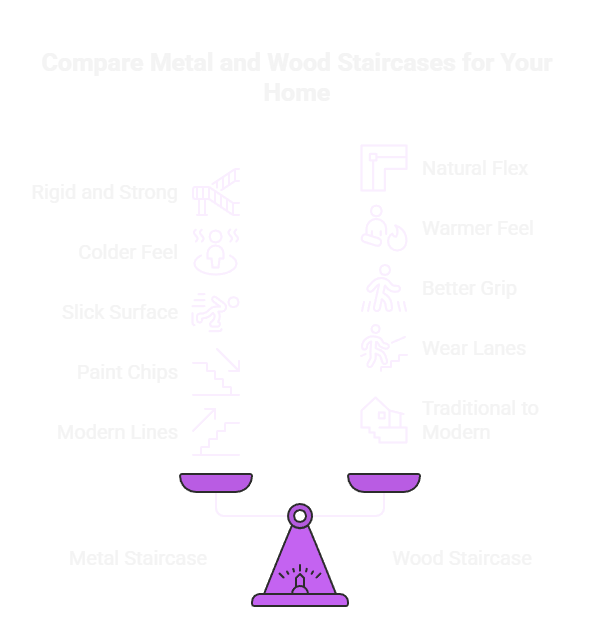
Side-by-side comparison removes guesswork. It helps you see where the trade-offs actually sit. No material wins in every category. Metal tends to win on slim structure and modern lines. Wood tends to win on comfort, traction, and repair flexibility.
The right choice depends on how the stairs will be used in your home.
Before diving into details, the table below sets the baseline.
| Comparison area | Metal staircase | Wood staircase |
| Material behaviour and structure | Very rigid and strong. Slim profiles are possible. | Strong with natural flex. Feels forgiving underfoot. |
| Comfort and daily use | Colder feel. More vibration and sound transfer. | Warmer feel. Quieter footfall and less vibration. |
| Traction and safety | Can feel slick if smooth or painted. | Better natural grip with proper tread profiles. |
| Maintenance over time | Paint chips. Touch-ups and rust prevention matter. | Wear lanes form. Refinishing and part replacement are practical. |
| Visual and architectural impact | Modern, industrial, minimal lines. | Traditional to modern. Easy to match interior finishes. |
A good staircase is never just a frame. Components decide how it feels. Posts, rails, and edges shape daily experience.
Many GTA homeowners who choose wood focus on a complete system, including stair posts and matching rail profiles, so the staircase feels cohesive instead of pieced together.
Is a metal staircase safer than a wooden staircase?
Safety questions usually surface after a close call. People want to know which material feels more stable during everyday movement.
A clear answer requires looking beyond surface labels. Safety depends on traction, edge control, and how the stair responds to different users. Material choice influences all three, but design decisions often matter more than people expect.
Slip resistance under normal use
Metal surfaces behave differently underfoot. Smooth steel or painted finishes can feel slick, especially in socks.
Added textures help, yet they change appearance and maintenance needs. Wood treads offer natural friction and respond better to subtle finish wear. Homes using hardwood stair treads often report more predictable footing during daily use.
Edge definition and nosing control
Edge shape controls how the foot lands. Rounded edges remove the stopping point during descent. Sharp, consistent profiles improve control regardless of material.
This is why stair nosings play a larger role in safety than most finishes. A well-defined nosing reduces forward slide and improves confidence.
Child and senior safety considerations
Children move quickly. Seniors move cautiously. Both benefit from warm surfaces, consistent step geometry, and quiet feedback underfoot. Wood absorbs vibration and reduces noise, which helps users sense each step.
Hand support matters too. Matching rails and posts, such as wood handrails and stair posts, add stability where it’s needed most.
Safety improves when stairs feel predictable. Predictability comes from consistent components, not surface tricks.
Metal vs wood staircase pros and cons
No staircase material is perfect. Each option brings advantages and trade-offs that affect daily living. A balanced comparison looks at how stairs age, how they sound, and how they get repaired. Understanding those differences upfront prevents disappointment later.
Pros and cons of metal staircases
| Aspect | Metal staircase – advantages | Metal staircase – limitations |
| Structural strength | High load-bearing capacity supports open, floating, and cantilevered designs without bulky framing. | Strength often exceeds residential needs, which can increase cost without improving daily comfort. |
| Visual profile | Slim profiles suit modern and minimalist interiors with clean lines and open sightlines. | Industrial appearance may feel cold or out of place in traditional or warm interiors. |
| Design flexibility | Enables dramatic architectural shapes, straight runs, and compact layouts where space is limited. | Design changes after fabrication are difficult and expensive to correct. |
| Resistance to biological damage | Not affected by pests, mould, or rot, making it stable in controlled environments. | Surface coatings still degrade over time, especially at edges and joints. |
| Dimensional stability | Does not expand or contract with humidity like wood. | Transfers temperature quickly, which affects comfort underfoot. |
However, Metal stairs work well in controlled environments and commercial settings. In homes, the feel matters as much as the look.
Pros and cons of wood staircases
| Aspect | Wood staircase – advantages | Wood staircase – limitations |
| Underfoot comfort | Warm and forgiving underfoot, especially noticeable in socks or bare feet. | Comfort depends on finish choice and maintenance over time. |
| Noise control | Absorbs impact naturally, resulting in quieter footfall and reduced vibration between floors. | Loose components or poor installation can still create noise if not built correctly. |
| Traction and safety | Better natural grip when proper tread profiles and edge geometry are used. | Traffic lanes can polish smooth if finishes are neglected. |
| Repair flexibility | Individual treads, nosings, or rails can be repaired or replaced without rebuilding the entire staircase. | Repairs require matching wood species and finish for best results. |
| Refinishing potential | Can be sanded and refinished multiple times, restoring appearance and grip. | Each refinishing removes material and must be planned carefully. |
| Visual integration | Blends easily with flooring, trim, and millwork for a cohesive interior look. | Visual consistency depends on careful material and colour selection. |
| Design adaptability | Works across traditional, transitional, and modern interiors. | Complex modern designs may require more skilled carpentry. |
| Long-term ownership | Offers lower lifetime disruption since components are serviceable. | Requires periodic refinishing as part of long-term care. |
| Moisture behaviour | Performs predictably in controlled indoor environments. | Sensitive to moisture if unmanaged, especially near entries or basements. |
| Wear pattern | Wears gradually and visibly, giving time to plan maintenance. | High-traffic areas show wear sooner than low-use stairs. |
A complete wood stair system allows components to wear evenly and be maintained without full replacement. That flexibility appeals to many GTA homeowners.
Metal vs wood staircase cost: what actually drives the price
Cost questions often focus on numbers. Real costs come from decisions made during planning. Fabrication, installation complexity, and maintenance rhythm shape the long-term budget more than material alone. Understanding cost drivers helps avoid surprises.
Fabrication vs carpentry labour
Metal staircases rely on fabrication. Custom steel requires precise shop work and specialised installation. Wood staircases rely on skilled carpentry. Custom wood involves milling, fitting, and finishing. Labour shifts rather than disappears. Locally produced stair components can simplify timelines and coordination.
Installation complexity
Floating designs, tight stairwells, and structural prep increase costs for both materials. Wood systems often integrate more easily with existing framing and finishes. Clean transitions at landings matter too. Coordinated floor transitions reduce finishing work and keep costs predictable.
Maintenance cost over time
Metal stairs need repainting or recoating when wear shows. Wood stairs need refinishing as traffic increases. Wood offers an advantage here. Individual treads or nosings can be replaced without dismantling the entire stair. Over time, that repair flexibility lowers ownership cost.
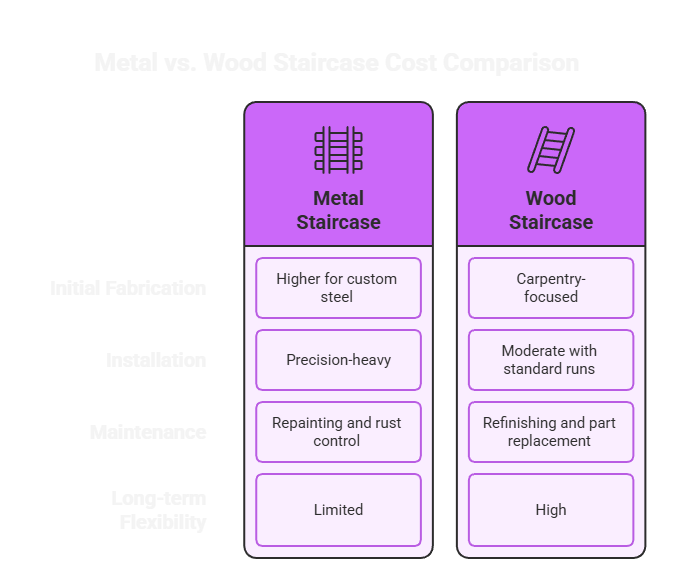
| Cost factor | Metal staircase | Wood staircase |
| Initial fabrication | Higher for custom steel | Moderate with standard runs |
| Installation | Precision-heavy | Carpentry-focused |
| Maintenance | Repainting and rust control | Refinishing and part replacement |
| Long-term flexibility | Limited | High |
Costs balance out when long-term use is considered. The right choice aligns with how the staircase will be used, not just how it looks on installation day.
Which staircase lasts longer: metal or wood?
Durability questions usually come from people planning to stay long-term. Longevity depends less on material labels and more on how stairs wear, get maintained, and respond to their environment.
Both metal and wood can last decades. They simply age in different ways. Understanding those patterns helps set realistic expectations before choosing.
Wear patterns over 10–20 years
Metal staircases tend to keep their structure intact. Wear shows first at edges, paint, and contact points. Chips, scratches, and exposed steel become the issue, not the strength. Wood staircases wear where people walk the most.
Traffic lanes polish smoothly, while edges soften gradually. A staircase built with consistent hardwood stair treads allows refinishing to reset wear without replacing the entire stair.
Environmental impact on lifespan
Indoor climate plays a major role. Metal reacts quickly to temperature changes and humidity, which affects comfort more than structure. Wood responds to moisture and dry air through expansion and contraction.
When the climate is stable and the materials are properly prepared, wood performs predictably. Homes that control humidity usually see long service life from quality wood stair systems.
Durability is not about which material never changes. It is about which material can be restored when a change happens.
Which staircase feels better in real homes?
Comfort rarely appears on spec sheets. It shows up during daily use. How stairs sound, feel, and respond underfoot affects how people move through their homes. These details matter more in residential spaces than in showrooms.
Noise and vibration during use
Metal transfers sound efficiently. Footsteps feel sharper. Vibration travels through the structure. Wood absorbs impact and dampens sound naturally. That softer feedback makes movement feel calmer, especially at night. Homes with open layouts often prefer wood stairs because noise does not travel as far between levels.
Temperature and underfoot comfort
Metal matches room temperature quickly. In winter, it feels cold. In summer, it can feel hard. Wood stays closer to ambient indoor temperature. Bare feet and socks feel more comfortable on wood year-round. That difference shapes daily habits, especially in family homes where stairs get constant use.
Comfort builds confidence. Confidence improves safety. Material choice quietly influences both.
Can metal and wood be combined in one staircase?
Many modern staircases use more than one material. Combining metal and wood allows designers to balance structure with comfort. The key is understanding which material does which job best.
Hybrid staircase systems
Hybrid systems often use a metal structure for strength and slim profiles. Wood handles the walking surfaces. Metal provides rigidity. Wood provides traction and warmth. A metal frame paired with quality wood stair treads offers a practical balance between performance and appearance.
When mixed materials make sense
Mixed materials work well in modern interiors that still value comfort. Open stairs benefit from steel strength. Daily use benefits from wood underfoot. Transitions matter here. Clean detailing at landings and edges, supported by matching floor transitions, keeps the staircase feeling intentional rather than experimental.
Hybrid stairs succeed when materials are assigned roles, not mixed randomly.
How to choose between a metal staircase and a wood staircase
Choosing well requires stepping back from trends. The right staircase supports how the home is actually used. A simple framework helps narrow the choice without pressure.
Traffic level and daily use
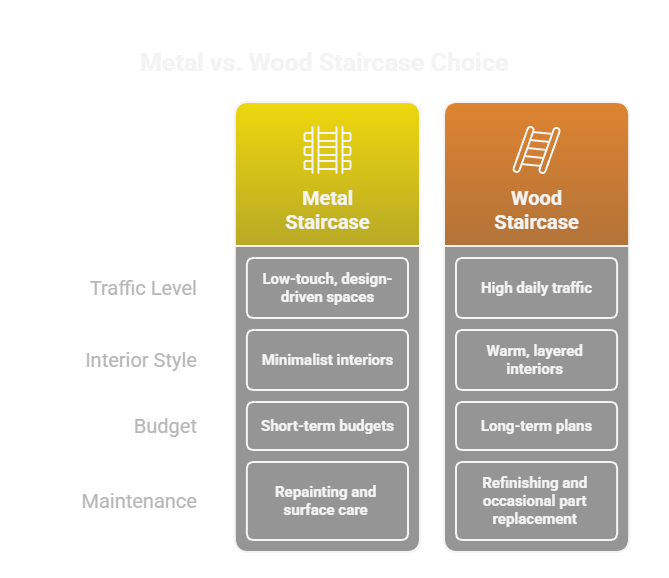
High daily traffic amplifies wear patterns. Wood handles frequent use well when built with stair-grade components. Metal suits lower-touch, design-driven spaces where structure matters more than comfort.
Interior style and finishes
Minimalist interiors often lean toward metal lines. Warm, layered interiors lean toward wood. Wood also integrates more easily with trim, flooring, and millwork throughout the home.
Budget and long-term plans
Short-term budgets may favour simpler builds. Long-term plans often favour materials that can be repaired instead of replaced. Wood offers flexibility through refinishing and part replacement.
Maintenance expectations
Metal requires repainting and surface care. Wood requires refinishing and occasional part replacement. Choosing the right stair components upfront makes either path manageable.
The best staircase is the one that fits your lifestyle quietly, day after day. If you want help reviewing real options, looking through past installations in the project gallery or booking a measured discussion through AV Hardwood’s appointment page often clarifies the decision without pressure.
Final verdict
Choosing between a metal staircase and a wood staircase works best when you slow the decision down. Metal staircases offer clear structural strength and suit modern, open interiors that prioritise slim lines and visual impact. Wood staircases take a different approach. They focus on comfort underfoot, predictable traction, and the ability to repair or refinish parts as life happens.
The better option depends on how the stairs will be used, not how they look in a showroom. Daily traffic, noise tolerance, climate control, and long-term plans matter more than trends.
In many GTA homes, a well-built wood stair system quietly outperforms fashion-driven choices because it adapts over time instead of demanding replacement.
If you’re planning a staircase upgrade, informed planning always beats rushed decisions. Reviewing real installations in the project gallery or having a measured discussion through AV Hardwood’s appointment page often clarifies the right direction before money is committed.
Frequently asked questions
Metal staircase vs wood staircase: which is better for homes with kids?
Homes with children usually benefit from warmer surfaces, quieter movement, and predictable traction. Wood stairs feel less harsh underfoot and reduce vibration noise.
Defined edges and solid rail support improve confidence. Many families prefer wood stairs built with consistent stair treads and properly shaped stair nosings for everyday safety.
Is a metal staircase slippery compared to wood?
Metal can feel slick when smooth or painted, especially in socks. Textures help, but change maintenance needs. Wood offers a better natural grip when tread profiles and finishes are chosen correctly.
Over time, worn wood can be refinished to restore traction, while worn metal usually needs recoating or specialist repair.
Does a wooden staircase require more maintenance?
Wood requires periodic refinishing, but maintenance is usually manageable and planned. Individual components can be repaired or replaced without rebuilding the entire staircase.
Metal stairs often need repainting or surface repair when wear shows, which can be more disruptive depending on the finish system.
Metal vs wood staircase cost: which makes sense long term?
Upfront costs vary by design. Long-term value depends on maintenance flexibility and repair options. Wood often makes sense over time because parts are serviceable and finishes can be renewed.
Metal can carry higher repair costs when coatings fail. Reviewing material options within a complete stair component system helps align the budget with expectations.