

Building wood stairs over concrete often sounds simple until safety enters the conversation. Concrete steps may look solid, yet they feel cold, slippery, and out of place beside wood finishes. Many homeowners reach this point after a near-miss or an uncomfortable descent, especially in wet weather or winter conditions.
The real risk rarely comes from the concrete itself. Problems usually begin when wood is added without rechecking stair measurements, edge geometry, or moisture behaviour.
If you are considering covering concrete steps with wood, the goal should never be appearance alone. Safe stairs depend on a consistent rise, proper tread depth, and edges that support the way people naturally move. Some solutions address the surface.
Others correct deeper structural issues tied to materials and sizing. This guide focuses on understanding both, so decisions are made once, not corrected later.
What is Building Wood Stairs Over Concrete
Building wood stairs over concrete means creating a full stair surface system on top of existing concrete steps. The process is not decorative cladding. A proper build accounts for stair height, tread depth, nosing shape, and moisture control.
Wood behaves differently from concrete, so the overlay must allow for movement and drainage.
Most successful builds treat the concrete as a structural base, not a finished surface. Wood stair treads, nosings, and framing elements are measured and installed as a complete stair assembly.
When done correctly, the result feels like a purpose-built staircase, not a cover placed over concrete.
Why Building Wood Stairs Over Concrete is Better
Concrete steps often remain structurally sound while becoming uncomfortable, slippery, or visually out of place. Many homeowners want the warmth and grip of wood without removing a solid concrete base.
Building wood stairs over concrete can solve those problems when the work is planned carefully and measured correctly.
Below are the practical reasons people choose this approach:
- Improving visual continuity with wood interiors
Wood stairs blend naturally with hardwood floors, trim, and railings. A well-matched stair system looks intentional rather than patched together. Stair projects often coordinate with other interior elements shown in real installations within the project gallery. - Increasing comfort and grip underfoot
Concrete feels cold and unforgiving. Properly finished hardwood stair treads provide a warmer surface and more predictable traction, especially during daily use. - Correcting worn or damaged concrete surfaces
Surface cracks and edge erosion remain visible on exposed concrete. A wood stair overlay allows clean tread and nosing lines without altering the concrete structure. - Making future maintenance easier
Individual wood stair components can be repaired or replaced without breaking concrete. Purpose-made stair systems support long-term upkeep more realistically.
Building wood stairs over concrete works best when visual goals and functional needs align. The next section explains why correct measurements decide whether the result feels safe or frustrating.
Now, let’s learn how to measure this in proper steps.
Building Wood Stairs Over Concrete: Measurements That Must Be Correct
Measurements decide success or failure in wood stair overlays. Even small errors change how a staircase feels underfoot. Concrete steps were poured to fixed dimensions. Adding wood alters those dimensions immediately.
Rise, run, and tread thickness must be recalculated before any material is cut.
Below are the measurements that must be correct:
- Total rise measurement before adding wood: Measure from finished floor to finished floor. Wood thickness changes the final height, especially at the top and bottom steps.
- Individual step rise consistency: Every step must stay within uniform tolerance. Uneven rise causes trips more often than slippery surfaces.
- Tread depth after overlay: Added nosings and tread thickness reduce usable depth. Stair treads designed for overlays account for this change.
- Nosing projection and edge definition: A proper nosing shape creates a clear stopping point for the foot. Accurate nosing geometry matters more than surface texture alone.
Here is a simple table view of the measurement area, what to check and why it matters:
| Measurement area | What to check | Why it matters |
| Total rise | Floor-to-floor height | Prevents uneven top or bottom steps |
| Individual rise | Each step height | Reduces trip risk |
| Tread depth | Finished walking surface | Maintains safe footing |
| Nosing projection | Edge overhang | Improves descent control |
Correct measurements allow stair components to work as intended. When stair treads and nosings are milled to consistent dimensions, finishes wear evenly, and grip stays predictable. Most failures happen before installation begins, not after.
Materials Used When Building Wood Stairs Over Concrete
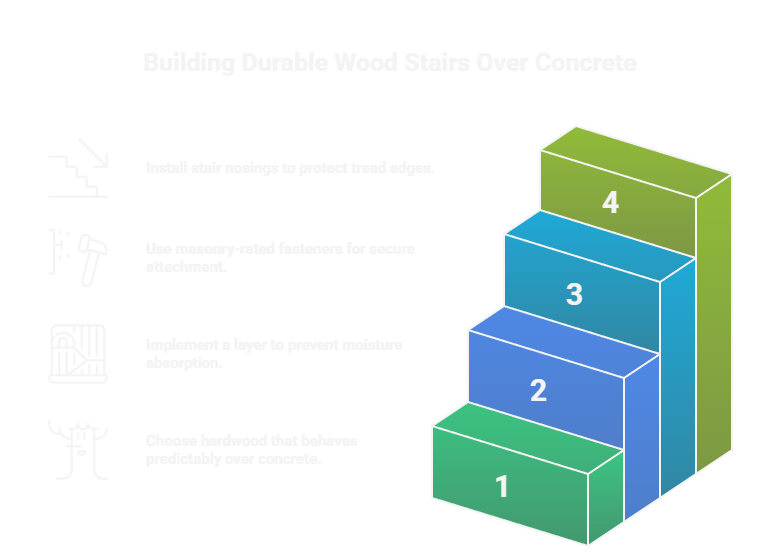
Material choice decides how long a wood stair overlay survives over concrete. Wood and concrete expand differently. Moisture moves through concrete even when it looks dry. Fasteners must hold securely while allowing slight movement.
When materials are chosen without considering these realities, stairs feel fine at first and fail quietly later. The goal is not strength alone. The goal is compatibility.
Below are the core material considerations:
- Wood behaviour over concrete
Solid hardwood behaves predictably when milled correctly. It finishes evenly and wears at a steady rate. Mixed-grade or low-density wood polishes unevenly and becomes slippery faster.
Purpose-made hardwood stair treads are designed to sit flat and accept finishes consistently, which matters when wood rests over a rigid concrete base.
- Moisture separation between wood and concrete
Concrete releases moisture long after curing. Wood placed directly on concrete absorbs that moisture unevenly. A proper separation layer allows airflow and reduces long-term swelling, cupping, and finish failure.
- Fasteners rated for masonry and movement
Standard wood fasteners fail in concrete. Masonry-rated fasteners secure the stair assembly while tolerating seasonal movement. Over-tightening creates stress points that show up later as squeaks or cracks.
- Edge components that manage wear
Stair edges take the most abuse. Properly shaped stair nosings protect tread edges and maintain a consistent foot stop during descent, which improves safety as the stair ages.
Good materials work quietly in the background. Poor materials demand attention later, usually when repair costs are higher, and options are limited.
Building Wood Steps Over Concrete: Indoor vs Outdoor Differences
Indoor and outdoor stairs may look similar on paper, but they fail in very different ways. Indoor stairs live in controlled conditions.
Outdoor stairs live in constant change. Treating both the same leads to short lifespans and repeated work. Understanding the environment helps set realistic expectations before building begins.
Before comparing details, it helps to look at the differences side by side.
| Factor | Indoor wood stairs over concrete | Outdoor wood stairs over concrete |
| Moisture exposure | Low and predictable | High and variable |
| Wood movement | Minimal seasonal change | Constant expansion and contraction |
| Finish performance | Long-lasting when applied correctly | Shorter lifespan due to the weather |
| Fastener stress | Stable | Repeated stress from temperature shifts |
| Common failure point | Polished tread surfaces | Moisture damage and edge breakdown |
Indoor stairs benefit most from precision-milled components and consistent finishes. Properly built wood stairs indoors often age evenly and remain comfortable underfoot. Outdoor stairs demand additional protection, drainage awareness, and realistic maintenance planning.
Cheap fixes tend to fail faster outdoors. Weather exposes every shortcut. Indoors, attention to geometry and finish quality usually delivers better long-term results.
How to Build Wood Steps Over Concrete Steps Safely
Safety comes from planning, not from adding products later. A safe build follows a clear process that respects stair geometry, material behaviour, and long-term use. This is not about step-by-step instructions. It is about understanding the order of decisions that prevent problems before they appear.
Below is the safe process logic:
- Evaluate the existing concrete first: Check level, slope, and edge condition. Severe cracking or uneven rise may require correction before wood is added.
- Recalculate stair measurements before design: Added tread thickness changes, rise and run. Measurements must be final before selecting materials or profiles.
- Plan the stair system as a whole: Treads, nosings, handrails, and posts should work together. Stair safety improves when components are designed as one system rather than added independently.
- Allow for movement and moisture control: Separation layers, fastening patterns, and edge spacing help the stair assembly move without damage.
- Finish after installation, not before: Finishing in place allows coatings to seal joints and edges evenly, improving durability.
A safe build feels intentional from the first step to the last. When stairs are planned as a system rather than a surface upgrade, long-term comfort and reliability follow naturally.
Common Mistakes When Building Wood Stairs Over Concrete Stairs
Most failed stair overlays fail for predictable reasons. The concrete base often gets blamed, but the real issue is usually planning. Small shortcuts compound over time. A stair might look fine on installation day, then feel unsafe a year later.
Understanding where projects go wrong helps avoid repeating the same cycle.
Below are the most common mistakes:
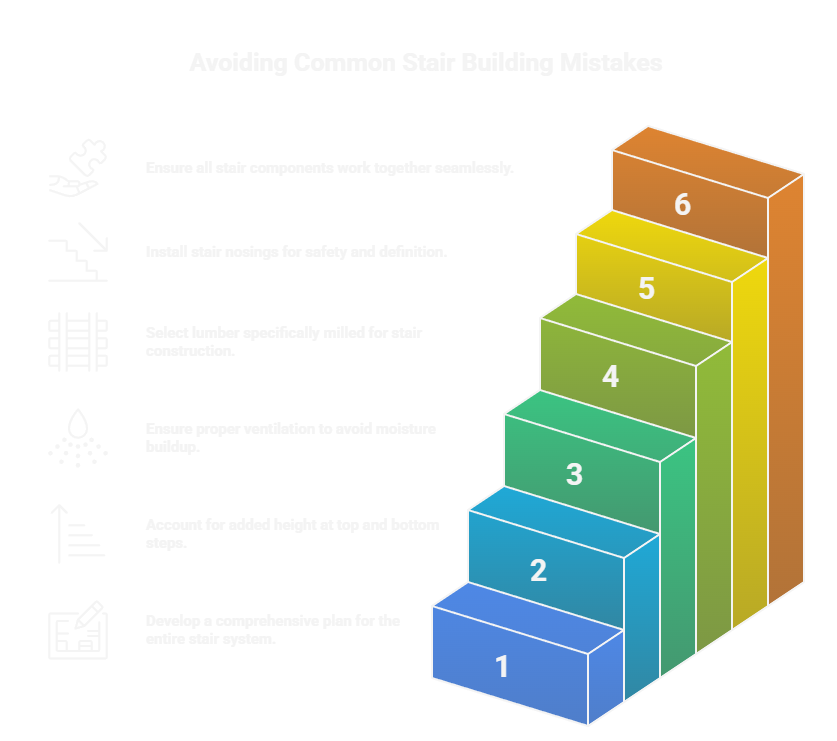
- Ignoring added height at the top and bottom steps
Adding wood changes stair geometry immediately. When rise becomes uneven, trips follow. Proper planning of a complete wood stair system prevents this issue. - Trapping moisture between wood and concrete
Concrete releases moisture long after curing. Wood placed directly on it absorbs moisture unevenly, leading to swelling and finish failure. - Using generic lumber instead of stair-grade components
Construction lumber isn’t milled for stair geometry. Inconsistent thickness causes uneven wear. Purpose-made hardwood stair treads hold shape and finishes far more reliably. - Skipping proper edge definition
Rounded edges remove the foot’s stopping point. Worn stair nosings increase slip risk even when tread surfaces look fine. - Treating stairs as separate parts instead of a system
Treads, nosings, handrails, and posts must work together. Mixing unrelated parts weakens safety and consistency.
Mistakes usually come from solving one problem at a time. Safe stairs come from planning the entire system before work begins.
When Surface Fixes and Generic Lumber Fall Short
Surface treatments feel reassuring at first. Anti-slip coatings, tapes, and textured finishes can help temporarily.
Trouble begins when those fixes are reapplied without lasting improvement.
Generic lumber polishes faster. Uneven tread thickness breaks uniformity. Poor edge geometry accelerates wear. Surface solutions cannot correct these flaws.
A well-built custom stair assembly does not rely on constant correction.
Why Purpose-made Stair Components Make the Difference
Precision matters more than products. Stair components milled to exact tolerances accept finishes evenly, maintain uniform rise, and preserve edge definition longer.
Solid hardwood components behave predictably over concrete. Expansion stays controlled. Wear stays consistent. Finishes last because the surface remains stable.
Custom sizing prevents subtle step differences that affect balance.
This is where working with a local manufacturer like AV Hardwood becomes practical rather than decorative. Supplying custom stair treads, properly shaped stair nosings, and complete wood stair systems allows the overlay to function as a staircase, not a surface cover.
DIY Fixes vs Long-term Stair Solutions
Quick fixes have a place. They also have limits. The difference between temporary traction and lasting safety comes down to what problem you are solving. Surface slickness and structural wear are not the same issue.
| Aspect | DIY traction fixes | Long-term stair solutions |
| Purpose | Short-term grip | Structural safety |
| Lifespan | Weeks to months | Years |
| Best use | Light wear, intact stairs | Worn treads, rounded edges |
| Risk | Peel, lift, wear unevenly | Higher upfront planning |
| What it cannot fix | Geometry, material quality | None if designed correctly |
DIY solutions can help, but they don’t correct worn stair geometry or low-quality materials. When the stair itself causes the problem, rebuilding the components delivers better outcomes than surface treatment alone.
Choose a Long-term Solution That Actually Lasts
Deciding what to fix starts with honest inspection. A stair that keeps feeling unsafe after every new coating usually signals deeper wear. The checklist below helps separate surface issues from structural ones.
Ask these questions:
- Are the stair treads polished or rounded in traffic paths?
- Is the stair nosing softened at the edge?
- Does the finish fail in the same spots repeatedly?
- Is the staircase used heavily every day?
In many cases, upgrading stair components provides better results than repeatedly adding surface products. A stair built on consistent parts supports every finish applied later.
Final Verdict
Building wood stairs over concrete can be a strong solution when it is approached as a structural upgrade, not a surface cover. Measurements decide whether the stairs feel natural. Materials decide whether they last. Safety depends on how well the stair system works together, not on any single product added at the end.
Surface coatings and quick fixes can help in the right situations. Still, repeated problems usually point back to worn tread geometry, softened nosings, or inconsistent sizing. When those elements are corrected, finishes perform better, and stairs feel predictable again.
This is where purpose-made stair components matter. Properly milled hardwood stair treads, well-shaped stair nosings, and a complete wood stair system work together to create stability over a concrete base.
When stairs are built as a system, not a patch, they age more evenly and feel safer every day.
If you’re planning a stair overlay and want it done once, not repeatedly corrected, take time to review the stair components themselves. You can explore custom stair solutions, view real project examples, or book a measured consultation directly through AV Hardwood.
Frequently asked questions
Can I put wood over concrete steps safely?
Yes, wood can be installed over concrete steps safely when measurements are recalculated and moisture is managed properly. Problems usually occur when wood is added without correcting the rise, run, or edge geometry. A full wood stair system handles these factors more reliably than surface-only solutions.
Do stair treads and nosings affect how slippery stairs feel?
Yes. Poor-quality or worn components reduce traction regardless of finish. Properly milled hardwood stair treads and well-shaped stair nosings maintain grip longer and allow finishes to wear evenly, which improves long-term safety.
Will wood rot if it is installed over concrete?
Wood can rot if moisture is trapped between the concrete and the wood. Safe installations include separation layers, airflow allowance, and appropriate material selection. When moisture is managed correctly, solid hardwood stair components perform predictably over concrete.
Are indoor and outdoor wood stairs over concrete built the same way?
No. Indoor stairs benefit from controlled conditions and consistent finishes. Outdoor stairs face moisture, temperature movement, and algae growth. Outdoor builds require different preparation, fasteners, and maintenance expectations than interior stair overlays.
When is refinishing not enough anymore?
Refinishing stops working when tread surfaces are polished smooth, nosings are rounded, or finishes fail repeatedly in the same spots. At that stage, upgrading stair components often delivers better results than adding another coating or traction product.
How do I know if I need custom stair components?
Custom components make sense when stair dimensions are inconsistent, traffic is heavy, or the overlay must correct existing wear.